'Act justly, Love tenderly, walk humbly with your God'
Micah 6.8
All posts by Stephen Cooke
NW NJPN E BULLETIN OCTOBER 2026
The October issue of the NW NJPN E BULLETIN opens with a statement from Bishop John Arnold, Lead Bishop for Environmental Issues for the Bishops’ Conference, for the Season of Creation highlighting how the world’s violent conflicts are impacting on our common home. He refers to Pope Leo’s message for the World Day of Prayer for Creation which ask us to work unremittingly for peace and to end the cycle of violence that destroys our common home.
Earlier this year Pope Leo released his first encyclical, Magnifica humanitas, addressing the rise of Artificial Intelligence and the need for technology to serve human dignity and the common good rather than driving inequality or replacing human conscience. The Catholic Union will be holding a webinar on Monday 19 October to explore how AI can enhance human experience rather than lessen it. See page 3. Embrace the Middle East, a founding member of the Just Peace Coalition,has released a statement in response to UK sanctions on Israeli settlements. Embrace’s Patron, the Rt Revd Rachel Treweek, Bishop of Gloucester, has visited Israel-Palestine on several occasions, to show solidarity with the Episcopal Diocese of Jerusalem and to continue listening deeply to the voices of people in East Jerusalem and the West Bank. In a lengthy article, Oranges and Lemons, which some may find harrowing, she shares her thoughts after a visit in January 2026, and reflects on her “deep disturbance at our inability to hold different things together in tension at the same time – things that might seemingly be different, even opposite.” She asks, “why is it that we have become a people of ‘either-or’ and rejected the ethos of ‘both-and’? Why can we not condemn the actions of this government of Israel regarding Palestine, and at the same time condemn antisemitism in the UK?” See pages 4-7.
Rabbis for Human Rights are mobilising staff, internationals, and Israeli volunteers to pick olives to support Palestinian families in many places across the Occupied West Bank as “a testament, first and foremost, to the failure of the Israeli state to uphold its commitments to democracy, justice, and security for all under its rule.” Read more on pages 7-8.
“The cry of displaced children rises to God today,” Pope Leo said in his Message for the 112th World Day of Migrants and Refugees, which the Church observed on September 27th. The Children’s Commissioner for England, Dame Rachel de Souza, echoed this theme, calling for greater protection of refugee and asylum-seeking children in the inaugural Jesuit Refugee Service (JRS) UK Annual Lecture. See pages 8-10.
This year, churches across the UK were invited to celebrate Disability Awareness Sunday on 27 September under the theme “One Body, Many Parts”, drawing on 1 Corinthians 12:12–27. Our Christian response asks us to be mindful of the needs of others at all times, not just on a designated day. Bishop Paul Hendricks, Auxiliary Bishop of Southwark, reminds us of Pope Francis’ words a few years ago, that “the Church must be for everyone, or else it’s for no one” in a reflection on page 10.
Regular contributor Jon Kuhrt asks, in this age of consumerism are we “stuck in receive mode” in our faith. He says, “Jesus does not call us to be religious consumers but calls us to build authentic community.” This theme will be explored in an online gathering on 29 September – details on how to join on page 11. Poet and priest Rev’d Jon Swales, founder of the Lighthouse Church in Leeds, will read his powerful poem The Gospel of the Wild Messiah at the event – we publish it on page 12 with a link to a recording by Jon.
The Catholic Union is holding a webinar on 15 October for young Catholics focusing on loneliness as spiritual crisis and political failure – see page 13 for details and please pass on to others who may find this helpful.
September 26 was the International Day for the Total Elimination of Nuclear Weapons. Find out more on pages 13-16, plus the latest news from CAFOD, Housing Justice, PACT (the Catholic charity supporting prisoners, people with convictions, and their children and families), Church Action on Poverty and Remembrance Sunday and a diary of regional and national events.
Apologies if you receive this bulletin from more than one mailing list.
The summer 2026 edition of the NJPN newsletter is now available,
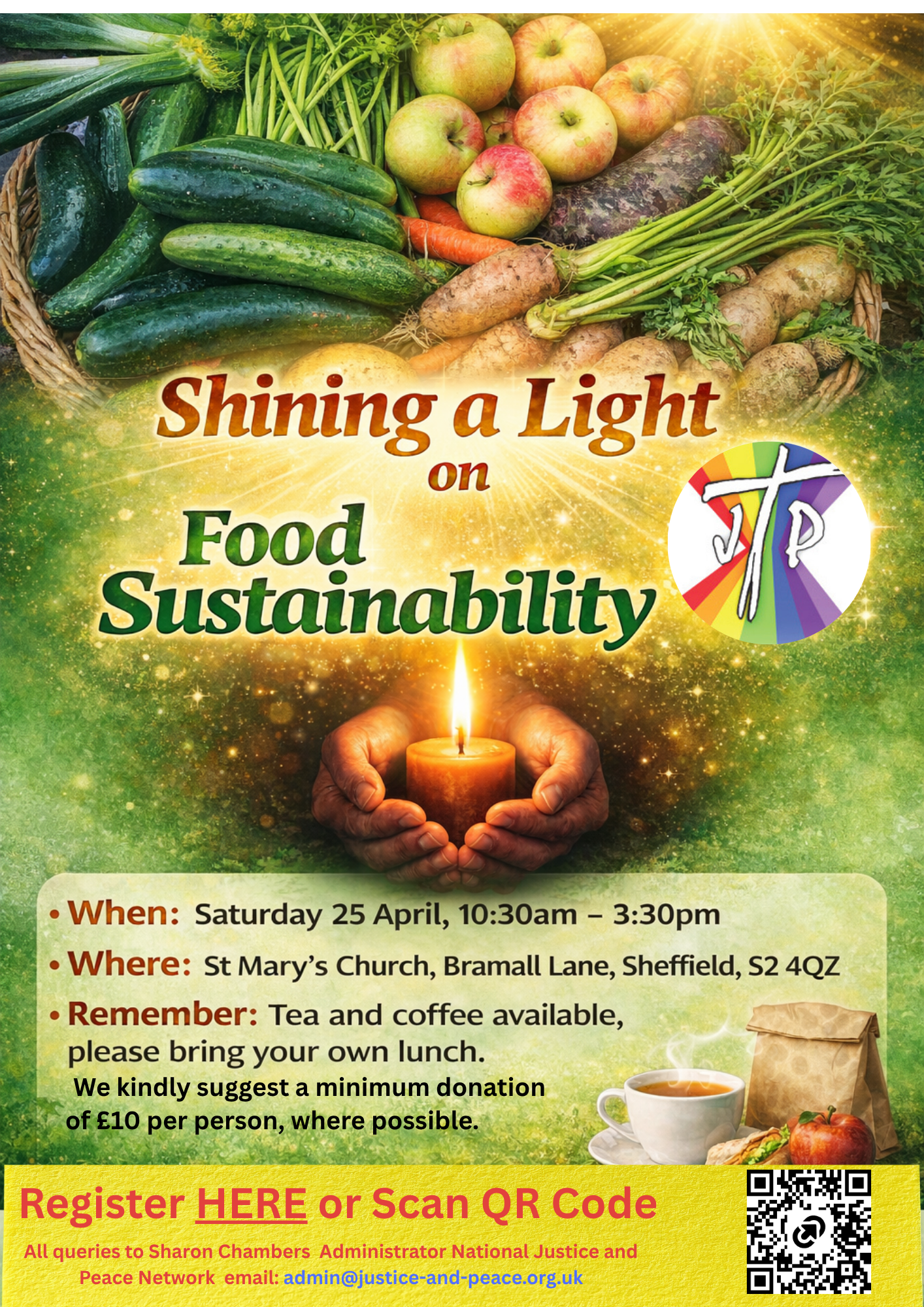
Featuring items on Building compassionate communities, news from our April event in Sheffield, Shining a light on Food Sustainability, and speaking personally with Brian O’Toole
The September issue of the NW NJPN E BULLETIN leads with NJPN’s July 2026 Conference on the theme ‘Just Talk’. The opening session posed the question, ‘What breaks your heart in the world today?’ There was no shortage of answers but sometimes it can be difficult to start a conversation, especially where views are radically different. Speakers shared stories of how looking at what we have in common, rather than focusing on what separates us, can be the way forward to meaningful dialogue and mutual understanding. Do use the links to the Conference videos on page 4 to revisit the talks or watch anew if you weren’t able to attend.
One of the Conference speakers, Billy Vaughan who works on political advocacy for Quakers in Britain explains why protest is part of dialogue on page 6 and another speaker, Liz Archibald, shares her involvement as part of an Interfaith group in the North East who hold a monthly prayer vigil outside the Derwentside Immigration Removal Centre. You can find her account on page 6 and a selection of the prayers and readings used on pages 7-8.
Six Catholic Priests representing the group Priests Against Genocide UK and Ireland – which includes three Cardinals, 28 Bishops and more than 2,500 Catholic priests and deacons in 67 countries – has sent an open letter to Prime Minister Andy Burnham urging his government to take decisive action on Palestine (see pages 9-10)
Reflecting on the death of British academic Jason Arday, The Rt Revd Dr Rosemarie Mallett, Anglican Bishop of Croydon and Acting Bishop of Southwark calls for compassion for those who struggle with oppression, with prejudice or mental health. You can read her heartfelt response as a Christian leader and a person of colour on page 11.
Pages 12-13 provide a round-up of special days and weeks throughout the Autumn: Season of Creation; World Week of prayer for Peace in Palestine and Israel; Fairtrade Fortnight; CAFOD Harvest Fast Day; Homelessness Sunday; Church Action on Poverty Sunday and Remembrance Sunday (see pages 12-13)
Regular contributor Heather Kiernan reports “[this week] the UN has harshly criticised Israel’s threat to evacuate people from areas where kites, drones and balloons are launched in Gaza, lamenting “unacceptable rhetoric” coming from Israeli leaders. Kites are being launched from Gaza by children searching for their innocent childhood amid the rubble. It is not about the kite; it is about the sense of freedom, flight and hope.” Heather shares a poem The Kite has no Passport by her friend Vijay Prasad (see page 13)
For those in the North West, there’s some stunning art on display at the Imperial War Museum North at Salford quays – a great day out opposite the Lowry Theatre and Lowry Art Gallery dedicated to Manchester’s most famous artist. The iconic cascading Poppies sculpture created in 2014 to mark the First World War centenary with a ceramic poppy commemorating the lives lost (see page 14 for details).
Christ Among the Ruins Finding Light in Gaza’s Darkness
A Collaboration between the NJPN UK & Pax Christi England and Wales on December 1st 2025. 🌿
Christ Among the Ruins: Finding Light in Gaza’s Darkness
A live webinar and conversation of faith, witness, and action
As the people of Gaza face unimaginable suffering amid ongoing bombardment, displacement, and humanitarian crisis — and as Israeli and Jewish communities worldwide grieve, fear, and struggle with the weight of violence and loss — we gather to seek Christ’s light among the ruins.
This webinar invited participants to reflect on how the Church understands and responds to this unfolding tragedy: where we find Christ in the midst of devastation, and how we can bear faithful witness to peace, justice, and compassion in a world so deeply divided.
Together, we listened to diverse voices — including perspectives from Activists both Christians & Jewish – Peace Advocates, and Church Leaders — to explore how followers of Christ can pray, speak, and act with integrity.
We also considered practical steps for advocacy, including how to engage elected representatives and support those most affected by the conflict.
The latest edition of Mouthpeace to available to download and read below
There are reports on the conference at Swanwick in July and also on various outings from groups. There is information about the Season of Creation, Pax Christi, the Week of Peace for Palestine and Israel and NJPN events on zoom to join. Also details about Fairtrade Fortnight, CAFOD Harvest Fast Day, Homelessness and Church Poverty Action Sundays. As usual there are several things you can join on line.
The July edition of the leads with details of a fantastic range of workshops on offer at the forthcoming NJPN Conference. There are a few places still available, including a discount rate for 18-35 year olds. Please contact NJPN Administrator Sharon at admin@justice-and-peace.org.ukif you’re interested, but do hurry!
The Just Peace Coalition, which brings together churches and Christian organisations across the UK, is inviting individuals, churches, and communities to join their Time to Act campaign and commit to working and praying for a just peace for all who call the Holy Land home. Heather Kiernan provides an update on the current situation in Gaza and a poem. Despite the pain and the loss, the poet says, “….if I were given another life another country, another fate—my soul would still walk barefoot toward Gaza.”
At a time when there are stories of racial tension and unrest, it’s heartening to hear of the Liverpool Interfaith Walk which brings communities together.Now in its fourth year, the July walk attracted more than 230 participants, with some travelling from well beyond the Liverpool region.
In a sermon given on Sunday, 5 July, Rev. Lisa Degrenia reflects on the World Cup currently hosted in her native USA in the light of the 250 th Anniversary ofthe Declaration of Independence and the current “downward spiral of ugliness, inequality, and harm.” But she gives a glimmer of hope, saying, “many of us are committed to embodying the vision of the founders in the Declaration of Independence. We hold these truths to be self-evident, that all men are created equal, that they are endowed by their Creator with certain unalienable Rights, that among these are Life, Liberty and the pursuit of Happiness.”
There are articles on Northern Ireland from regular contributorsIan Linden and James Gordon Reid Havelock-Jones. James comments on a recent racist incident which “exposed a deeper wound in the Irish body politic” and suggests “a four‑stage horizon for Christian engagement with racial injustice” inspired by the words of Archbishop Desmond Tutu. Ian, looking back to Belfast in the mid-1980s and returning recently, was sad to see how little had changed. Deborah, a Tamil Christian who moved to the UK 25 years ago fleeing civil war, shares her story in a guest blog for Church Action on Poverty. She now works to advance justice for disabled and migrant communities.
In other news, the UK Government has announced that it is pursuing plans for Religious Education to form part of the new national curriculum, after a consensus was achieved with faith groups about programmes of study. More than fifty humanitarian, climate and peacebuilding organisations are urging Keir Starmer to rethink Britain’s growing military spending, ahead of the NATO summit in Ankara and we have details of events planned in Chester and Liverpool in August to commemorate the bombing of Hiroshima and Nagasaki.
The themes of compassion and tolerance run through the June edition of the NW NJPN E Bulletin, leading with a challenging op ed from Colette Joyce on the killing of Henry Nowak and a powerful reflection and poem from Scottish Minister Eleanor Hamilton, inspired by the callous mocking of asylum seekers who died trying to cross the Channel. She says, “maybe today we choose compassion over cruelty. Maybe today we remember who we’re called to be.”
Pope Leo XIV’s first encyclical letter, Magnifica humanitas, is examined by Professors Ian Linden and Anna Rowlands who calls the text “a gift to the world.”
‘Superpower suicide’ is a striking phrase used by the historian of totalitarianism, Professor Timothy Snyder. Jesuit priest Chris Chatteris examines Snyder’s argument that “the United States is in the process of committing ‘superpower suicide’, thanks to the Trump administration’s geopolitical blunders. Two egregious examples are the unwinnable war with Iran and the inexplicable alienation of its traditional allies in Europe.” Fr Chatteris adds, “It occurs to me that the United States is not alone. Witness the fatal self-harm that Putin’s Russia is inflicting upon itself, by hubristically taking on Ukraine in a war which Russia is losing and which is destroying its economy.”
Jan Harper from Merseyside Pax Christi reports on an online event from Pax Christi International which gave an opportunity to hear first-hand from Taybeh, one of the earliest Christian villages in Palestine, currently suffering persecution. Regular contributor Heather Kiernan shares news of the continuing violence on Gaza, accompanied by two poems. Ukrainian writer Yuliia, now based in Wales, provides context to the current situation in her homeland, tracing the persecution of her people back to the Holodomor of 1932-33 – the famine created under Stalin’s Soviet regime. She reveals her own experience of being a displaced person.
Continuing the theme of reconciliation, regular columnist James Gordon Reid Haveloch-Jones says that “the call to reconciliation remains at the heart of Christian discipleship.”
Refugee Week runs from 15-21 June this year. The Manchester based Boaz Trust offers a prayerful reflection on the theme of courage which they say is “more relevant than ever. With the rising popularity of far-right politics, and the intensifying scapegoating of people seeking safety in the UK.”
Following his retirement as England football manager, Sir Gareth Southgate is transferring his skills to addressing the lack of role models for boys and young men, an issue he focused on in last year’s BBC’s Richard Dimbleby Lecture. In a BBC documentary 8 June (available on iplayer) he examines how young men struggling to find work, particularly those who did badly at school, can suffer a cascade of problems later on in life including poor mental health and loss of identity. These concerns are also addressed in former Labour minister Alan Milburn’s review into the rising number of young people Not in Education, Employment or Training (NEET), released on May 28.
Fr Joe Ryan gives a comprehensive report of Pax Christi England and Wales’ AGM on 6 June on the theme “Sowing seeds of Hope.”
Finally, I’m delighted to report that 8 members of the St Vincent’s Altrincham CAFOD/J&P group (my parish) are to be presented with a Papal Blessing in recognition of their dedicated work for CAFOD over the past 46 years.
The summer 2026 edition of MouthPeace is available,
There is information on a variety of topics – peace issues with Pax Christi, reports on the NJPN day in Sheffield on Food Sustainability from various perspectives and details of Green Week Events in the North West. There are also links to Pope Leo’s Encyclical, the Caritas report on The Dignity of Workers, the Columban’s Vocation for Justice summer edition which is now digital and recordings of speakers at the National Emergency Briefing at Westminster Hall last November. There are online petitions to sign and webinars to join.